Training Guides / Exercise library
The conventional deadlift
The deadlift trains the whole back side of the body by lifting a loaded bar from the floor. Learn the five-step setup, how to keep a neutral back and which variation to start with.
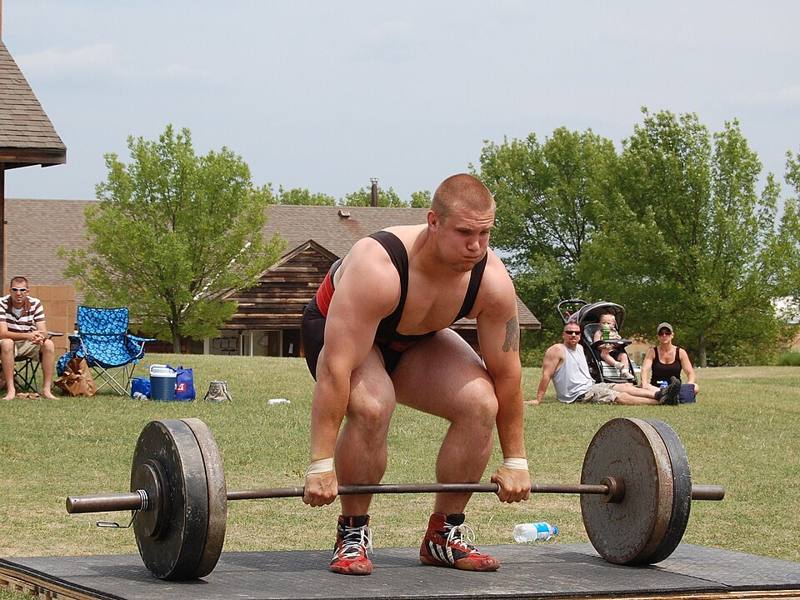
The deadlift is the simplest way to measure how much you can pick up. You grip a barbell on the floor and stand up with it. Because the bar starts dead still on the floor every rep, there is no bounce to help you.
General education only. If you have a history of back pain or injury, get guidance from a qualified professional before deadlifting.
Muscles worked
The deadlift is a hip hinge: the hips move back and forward while the spine stays still. The main movers are the glutes, hamstrings and adductors. The spinal erectors work hard to hold the back in position, the lats keep the bar close, and the forearms and upper back hold everything together. Few exercises train so much muscle at once, which is also why it is tiring and does not need high volume.
The five-step setup
- Feet. Stand with the bar over the middle of your feet, feet about hip width, toes slightly out.
- Grip. Hinge down and grip the bar just outside your legs with both palms facing you.
- Shins. Bend the knees until the shins touch the bar. Do not let the bar roll forward.
- Chest. Lift the chest and flatten the back. Think "proud chest" and pull the shoulder blades down.
- Pull. Take a breath, brace the abs, take the slack out of the bar until it presses against the top of the plate holes, then push the floor away.
Form cues
- Bar stays close to the legs the whole way up. A bar that drifts forward multiplies the load on your back.
- Hips and shoulders rise together. If the hips shoot up first, the weight shifts to the lower back.
- Finish tall. Stand straight with the glutes squeezed. Do not lean back at the top.
- Lower with control. Push the hips back first, then bend the knees once the bar passes them.
- Reset each rep when learning. Touch-and-go reps are fine later, as long as each rep starts from the same position.
Common mistakes
| Mistake | Fix |
|---|---|
| Rounding the lower back | Lower the weight, tighten the brace, start with the bar higher on blocks |
| Squatting the bar up (hips too low) | Raise the hips until the shoulders are slightly in front of the bar |
| Jerking the bar off the floor | Pull the slack out first, then squeeze it up |
| Bar far from the legs | Engage the lats: "bend the bar around your shins" |
| Hyperextending at the top | Finish with the glutes, not by leaning back |
Variations
- Trap bar (hex bar) deadlift. You stand inside the bar, so the load is closer to your center. Easier to learn and a great choice for most people.
- Sumo deadlift. Very wide stance with hands inside the knees. Shorter range of motion and more inner-thigh work.
- Romanian deadlift. Starts from the top and focuses on the hamstrings. See the Romanian deadlift guide.
- Rack pull or block pull. Bar starts above the floor, useful for learning or working around limited mobility.
Programming and safety
Because it is so demanding, many programs deadlift heavy only once or twice a week, often for 1 to 3 work sets of 3 to 5 reps after warm-ups. Use a mixed grip (one palm forward, one back) or lifting straps only when your grip is the limit, and switch which hand faces forward from set to set.
Stop the set if your back position changes. A rep that rounds and wobbles is not worth the risk. Leave one or two reps in reserve on most sets; see sets, reps and RPE.
Pair the deadlift with lighter hinge work such as the hip thrust and keep a training log so you can see the numbers climb over months, not days.