Training Guides / Exercise library
Parallel bar dips
Dips are a powerful bodyweight press for the chest, triceps and shoulders. Learn safe depth, form cues, scaling options and when to choose a different exercise.
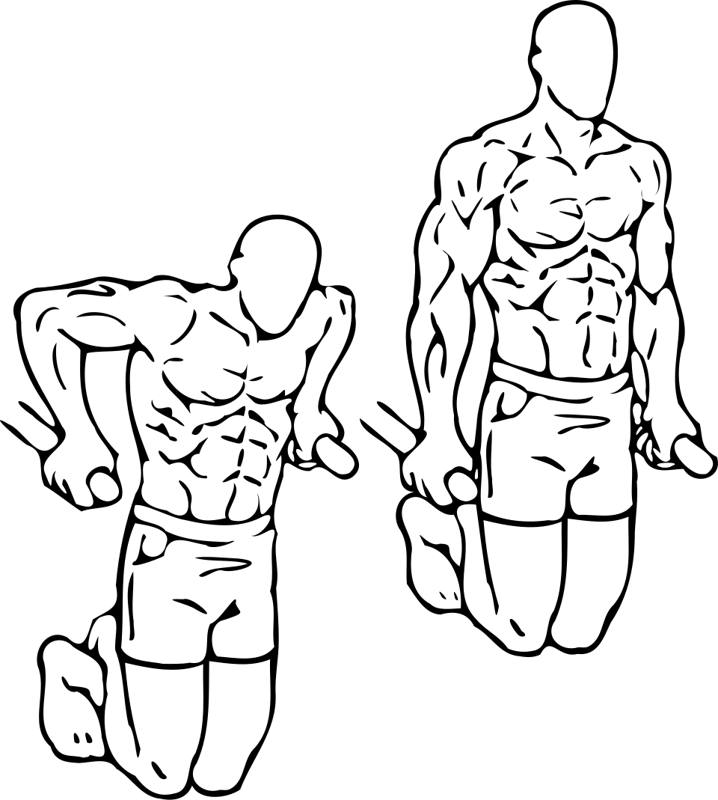
A dip means supporting yourself on two parallel bars with straight arms, lowering your body by bending the elbows, then pressing back up. It is one of the most effective bodyweight exercises for the lower chest and triceps, and it can be loaded with a dip belt once bodyweight becomes easy.
General education only. Dips place the shoulder in a deep stretched position. If you have shoulder pain or past shoulder injuries, get advice before doing them, or choose an alternative below.
Muscles worked
| Muscle | Role |
|---|---|
| Triceps | Straighten the elbows, the main mover in upright dips |
| Pectoralis major (lower fibers) | Press the arms down and forward, more involved with a forward lean |
| Anterior deltoid | Assists the press |
| Lower trapezius and serratus | Stabilize the shoulder blades |
Form cues
- Start at the top with arms locked, shoulders pressed down away from the ears.
- Lean slightly forward and lower under control by bending the elbows.
- Elbows point back, not flaring wide.
- Depth: lower until the upper arm is about parallel to the floor, or to a depth that feels strong and pain-free. Going much deeper adds shoulder stress for most people without much extra benefit.
- Press back up to full lockout. Keep the legs still, crossed behind or straight in front.
An upright torso focuses more on the triceps; a forward lean of 20 to 30 degrees brings in more chest.
Common mistakes
- Shrugging at the bottom so the shoulders roll forward and up.
- Dropping fast into the bottom and bouncing.
- Going too deep before the shoulders are ready.
- Half reps at the top only.
Scaling options
| Level | Variation |
|---|---|
| Easier | Bench dips (hands behind you on a bench, feet on the floor), band-assisted dips, assisted dip machine, negative-only dips |
| Standard | Bodyweight parallel bar dips |
| Harder | Weighted dips with a belt or dumbbell between the feet, slow tempo dips, ring dips |
Bench dips are popular but put the shoulder in an awkward position for some people. If they cause discomfort, use band-assisted parallel bar dips or close-grip push-ups instead.
When to choose something else
If dips bother your shoulders even at a shallow depth, skip them. Close-grip bench press, close-grip push-ups, cable pushdowns and overhead triceps extensions train the same muscles with less shoulder stress.
Programming
Use dips as a second pressing exercise after the bench press or push-ups, for 2 to 4 sets of 6 to 15 reps. Once you can do 3 sets of 12 to 15 clean reps, add 2.5 to 5 kg (5 to 10 lb) with a dip belt. The arms guide covers triceps volume in more detail.